Powered By Blogger

Wednesday, November 30, 2011

Mr. Thoreau, Libraries, and The Importance of Checking Out Sources

These days, lots of people use snappy quotations in their email signature blocks.  

Some use the words of Transcendentalist thinker and pencil manufacturer Henry David Thoreau.  You know, the “Walden” guy, pictured at left.

A few days ago, I read an email by a properly degreed librarian and certified archivist that contained the following snappy quote, along with the author’s name, in the signature block.  It read: 

"Libraries will get you through times of no money better than money will get you through times of no libraries." -- Henry David Thoreau

Wait a minute . . .

There was something about that quotation in the writer’s email signature block that didn’t ring true.   

First off, it was not written in a style that was in any way similar to that 19th century Transcendentalist style of Thoreau’s time. Secondly – and much more important – it was a-historical.

The quotation seems to suggest that Thoreau thought that libraries, -  you know, those “free and open to all” institutions,  -  can “get you through times of no money” which would of course be far better than being rich, but having no access to libraries.

In other words, when there’s no money, there’s always the library.

As far as the lofty thought goes, there’s not much to argue with here, except that “free libraries open to the public at large” were not much of a part of Thoreau’s universe. In fact, because of a simple accident of birth, Thoreau would not have had much experience with using libraries in a time of no money.

You see, he was born too early to have spent much – if any – time in libraries that were free and open to all.

There were, of course, some great libraries in large cities during Thoreau’s time, but they were not free.  They were subscription libraries, with paying shareholders and paying members. Generally, they existed for the almost-exclusive benefit of their paying members.  The occasional visiting (male) scholar was often given temporary on-site privileges at the library,   but local (male) residents were expected to pay for their library privileges. Libraries and money went hand in hand. In times of “no money” there was not much in the way of library access.

Although shareholder-funded libraries and some guild-like “mechanics’ libraries” had been around in North America since the late 18th century, they appealed largely to the well-to-do urban male citizens. Females were permitted few prominent civic roles in the early new republic. Subscription libraries did not admit them as regular members, shareholders or subscribers, although a tiny number of women who had achieved renown as scholars or writers were occasionally given temporary visiting privileges.

Paying male subscribers thought that having women in libraries was, well, unseemly and distracting.  Besides, what could there be in libraries that would have even the slightest interest to women? Plus, aisles were narrow and there were stairs, so women, with their long dresses, would be in constant danger.

Of course, women were not totally left out in the cold.  During the 1830s, the “lyceum movement” got underway in Massachusetts, and lyceum-sponsored “winter lectures” by important public intellectuals were given in cities and small towns in the northeast. Admission was sometimes free, and sometimes not, but still, the lectures were open to all, men and women alike.

The early 19th century was a time of progressive self-improvement, led mostly by educated and civic-minded males in the northeast. It was during this time that the “social library” movement also began, primarily among those well-educated young men in urban areas. 

An early example of this concept, the “Young Mens’ Association for Mutual Improvement in the City of Albany” was established in 1833 and chartered by the New York State Legislature in 1835.  Its founder, Amos Dean, a young Union College graduate (where he had helped establish the Kappa Alpha Society, the nation’s first literary social fraternity) was elected the YMA’s first president and gave one of its first lecture series  - on the “new science” of phrenology. Dean, an Albany lawyer, was also later selected to be the first president (1855 – 1859) of the University of Iowa, running things mostly long distance from his law office in Albany.

(note: I was on the board of the “YMA” [dba the “Albany Public Library”] for lots of years and am currently the archivist and a past president of the Executive Council of the Kappa Alpha Society, so I consider the long-deceased Amos Dean an old friend and mentor)

Similar “young mens’ associations” – all precursors of the modern public library - were established in Troy (1835), Buffalo and Rochester (1836) and Schenectady (1839).

By 1853, the YMA for Mutual Improvement in the City of Albany had more than 1700 members. With a lecture hall with seats for 800 and a reading room stocked with the leading newspapers and periodicals from around the country and from England, the YMA was one of the cornerstones of intellectual life (at least for men) in Albany.  While the library had amassed more than 10,000 volumes, it was hardly the publicly funded library that we think of today when we say “public library”. It had an income of slightly more than $5000 and annual expenses of about $4500.  Its revenue came from the sale of lecture tickets, annual membership subscriptions (originally $2) and voluntary member contributions.  None of it came from public sources. More important, it was still largely a membership organization. 

Many years later, its book collection would become the nucleus of the Albany Public Library. Even though it became a "public" library, it was still - officially - known as the "Young Mens' Association for Mutual Improvement."  Traditions die hard in a city chartered in 1686.

But, during Thoreau’s time, it was a membership institution, open to all  -  at least, "all" with two bucks to spare.

In a word, in 1853, the concept that there would be many libraries that would receive public funding and would therefore be “free to all” was still far in the future. How far?  Much farther in the future than the death of Henry David Thoreau, only nine years later in 1862.  The Boston Public Library, the first publicly-supported library in the United States, chartered in 1848, did not actually open its doors until 1854. Other “free to all” public libraries wouldn’t appear until the end of the century.

Thoreau said and wrote lots of things during his life.  However, a little research showed that, as I suspected, the quote about libraries and money was not his at all, even though it shows up on any number of “official” public library sites and has even made it into their “official” newsletters and publications.  

(second gratuitous note: I am resisting the temptation of linking to all the public library sites that attribute this quotation to Thoreau. It's hard, but I'm doin' it anyway...)

In fact, it’s listed on the authoritative Walden Woods Project’s “Mis-Quotation Page”, second quote from the bottom.  Interestingly, the page gives the history of the mis-attribution and the original source from which it was adapted.  Rather than spoil the fun, I’ll let you check it out for yourself here.

You'll also learn lots more about Thoreau by poking around the Walden Woods Project site.

The takeaway here should be simple, at least for genealogists.  

One: It pays to check out all sources and attributions carefully; not everything is as we would want it to be.   

Two: Lots of stuff on the ‘net is not right.   

Three: even credentialed and certified professionals can be wrong from time to time, especially if they fail to check stuff out carefully, thus “caveat lector.”

Bottom line:  Verify! Verify!  (Yeah, I know - Thoreau said, "Simplify! Simplify", but what the hey!)

Tuesday, November 22, 2011

Putting a Little Heat in Thanksgiving: Occupy History!

So, I’m thinking … the traditional Thanksgiving turkey dinner with all the fixins’ is kinda bland.  Not much in the way of gastronomic punch.  Basic bland gravy.  Basic bland potatoes.  Basic Bland Bird.

So, what to do?

Well, now I’m thinking that the folks at UC Davis Police Department may have had the right idea after all. 

Nothing like a little pepper spray to liven things up. 

After all, the good folks at Fox News – in the person of Ms. Megyn (“it’s a food product, essentially”) Kelly – have apparently decided that military grade pepper spray is some kind of tasty food item, and therefore, eminently suitable for the Thanksgiving table.  After all, it’s derived from pepper (which lots of people eat) and even appears with other edible peppers on the Scoville scale (see above)  -  although it’s somewhat off the charts, being ten times "hotter" than habanero peppers.   

You can get more info about this kind of industrial-strength pepper spray from Pulitzer Prize author and science writer Deborah Blum’s blog here.  

I guess that for Fox News viewers, the mustard gas used in World War One would be some kind of condiment as well, to add zest to those bland Boche sausages…

Of course, if you watch a lot of Fox News, you’re likely to have a somewhat skewed view of reality.  At least that’s what a recent study done by the folks at Fairleigh Dickenson University seems to show.  

Sure, I know it’s hard to believe that watching Fox News can actually make you about 18 percentage points stupider than folks who watch nothing at all, but the study seems to show that to be the case. 

For example, Fox News viewers and radio talk show listeners think that the protesters in Syria have already effected regime change there.  Apparently nobody’s told Syria's Bashar al-Assad that he’s out of work and, chances are, he doesn’t watch Fox News. (Of course, to some folks, all those Middle Eastern types all look alike.  Al-Assad, Gadhafi, Mubarak… what’s the difference???)

Chances are, you’ve never lived in a “third world” country.  I have.

Chances are, you’ve never experienced the militarization of the local police before.  I have.

Chances are, you probably think that if you just mind your own business, don’t get too deeply involved and just spend your time doing your genealogy, everything will be all right.  It won’t.

When Thanksgiving rolls around in a few days, and you brush off your family group sheets and remember your Mayflower ancestors, remember also that they were Separatists and Dissenters. 

Whatever the "status quo" was at the time... they were not a part of it.

They were not the folks in power and they were not the folks in political control in their own country.  They had more in common with the folks at Davis who were pepper-sprayed than with the folks in uniform with the canisters. In many respects, they were much like the Occupy Wall Street (or Oakland, or Albany, or Boston or Paris.... well, you get the idea....) folks.

Oh no, you say... my Pilgrim folks were all about religion, not politics.  Quick reality check: in the 17th century, religion and politics were pretty much inseparable.  The concept of "separation of Church and State" was still a long way off.

Chances are, there were also powerful folks in England in 1620 who thought that those annoyingly scruffy Mayflower passengers could greatly improve their lot in life if they’d just take a bath and get a job.

Sound familiar?


Monday, November 21, 2011

Ruhleben: Germany’s Race-Course/ Concentration Camp for British Subjects in World War One

Genealogical and historical treasures can pop up online in the strangest places.

For example, who would ever think to look on the Harvard Law School Library’s Special Collections area for the new digital exhibition about a German “concentration” camp for British subjects during World War One?

Frankly, how many folks have ever heard about Ruhleben, a former racecourse turned WWI internment camp about 10 kilometers from Berlin?  Or the folks that spent the duration of the war there?

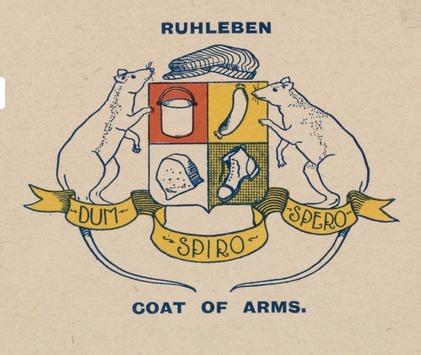
Or that the "residents" designed their own municipal coat of arms?  (Note the "rats rampant" in the illustration above left...)

And if they ever heard of Ruhleben at all, how many knew how it operated (hint one: the “guests” ran it), and what went on there?  (hint two: its own newspaper, plus theatre and musicals and lots, lots more kept folks from going stir-crazy)

The collection (well, actually TWO collections: the Maurice Ettinghausen collection and the John Cecil Masterman collection) have been digitized and are now available for study on the Harvard Law School Special Collections website.  It’s brand-new and well worth checking out. Here’s the link:


It’s a well-thought-out and intuitively-designed website and conveys lots of information in a highly graphic way.  Frankly, most people will find it more than a little bit interesting, since “most people” probably have no idea that the German government rounded up so many male “enemy aliens” and sequestered them in a place like Ruhleben for the duration of the war. All in all, about 100,000 people spent at least part of the war in these kinds of camps.

Many of the Ruhleben “guests” were British businessmen working in Germany, while others were students and teachers.  Only males between the ages of 17 and 55 were interned, and about 5,500 people spent a large part of the war in the makeshift village-camp known as Ruhleben.

Not all of the thousands of Ruhleben residents were obscure English businessmen and commercial travelers.  The “guest list” also included athletes, musicians and scientists who were studying or resident in Germany before the War, many from Commonwealth nations, including Canadian composer and conductor Ernest MacMillan and later Harvard professor Winthrop Pickard Bell, familiar to many genealogists for his work on early “foreign Protestants” in Nova Scotia.  “Prince Monolulu” (the West Indian born Peter Carl MacKay) horse-racing tipster and probably the best-known black man in English racing circles after the war, was also a guest at the Kaiser’s Ruhleben race course.

It’s important to note that the Harvard Law School site is not the only source of information about the Ruhleben camp.   Since it was a camp that housed British nationals, it’s only natural that there would be additional information in the U.K. National Archives.

(Note: those with possible family members interned at Ruleben will find the many references and links helpful.)


You can search the links on the left-hand side of the page for the names (and short biosketches) of many who spent time at Ruhleben as “guests” of the German Imperial government.

The Harvard Law School website raises two interesting legal questions, which I suspect that genealogists will also find interesting – especially if they’re researching military ancestors:  the first question: what exactly is a “concentration” camp and is it different from an “internment” camp or some kind of “prisoner of war camp”?    The second question: what is the legal status of “civilian” (i.e., non-combatant) internees and, by extension, how do their “rights” differ from those of “prisoners of war” under international law?

Nothing about what we do is ever simple.  Still, the spanking-new “Ruhleben” website certainly helps to shed new light on the “war to end all wars” and, in the process, gives us new things to think about.

Sunday, November 20, 2011

Denisovan DNA, Neanderthals and Bruce Trigger

Neanderthal Ancestor?
No, that's not me on the left - but there are days when I feel like that.

In fact, that Neanderthal gentleman may be one of my remote ancestors.

But first, a short story -

I was a serious, archives-haunting, microfilm-scrolling genealogist for some years before I was a university undergraduate.  I had the charts and family group sheets to prove it.

Of course, way back then, I viewed the world through the eyes of someone raised in the western/ European tradition, and had little knowledge of other non-Western kinship systems.  It took a university professor – the brilliant Bruce Trigger – to open my eyes to the myriad possibilities of the word “family.”

Dr. Trigger (1937 – 2006) was an anthropologist and ethnohistorian.  When he taught me the basics of anthropology way, way back in 1964, he had just arrived at McGill University with a brand-new Ph.D.  His background was in ancient African (Nubian) cultures, and his best work, on the Huron of North America, was still yet to come.

The anthropology course itself was new – so new that it didn’t even have a text.  Just Dr. Trigger’s handouts and reading lists.

Dr. Trigger wasn’t a genealogist, but as an ethnohistorian and anthropologist,  he took the broad idea of family seriously.  He pointed out that the word means wildly different things in different cultures.  People who are “closely related” in one culture might not be so in another culture. Biological relationships are not necessarily family relationships.  In other words, “families” are largely artificial constructs, varying from time to time and culture to culture.  This was all heady stuff.

Moreover, those artificial cultural definitions were also used to define exactly who was an eligible marriage partner and who wasn’t.  The further back in time the discussion went, the murkier things got.  People mated for all kinds of reasons and didn’t necessarily become “family” by so doing.

This, of course, was well before the DNA concept had taken hold in both anthropology and genealogy.  Work on historic family/genetic relationships was still largely based upon eliciting information from “informants”, especially in cultures where there are not written texts.

I spent part of that year researching and writing about the marriage customs and family definitions of a small group of islanders who lived in the Solomon Islands on a small atoll called Tikopia.   The talented and very long-lived New Zealand ethnologist and anthropologist Raymond Firth (1901 - 2002) had written the definitive work on the islanders, called We, the Tikopia: A Sociological Study of Kinship in Primitive Polynesia.

Over the months, I practically memorized the book in its entirety.

In a way, it was probably the most important “genealogy training manual” that I ever studied, largely because it forced me to re-examine all those things that I thought were “universal”, but turned out not to be.  (as an aside - Firth, an eclectic researcher, had been the research assistant to Sir James Fraser, author of The Golden Bough – the Modern Library edition of which I read several years before taking Bruce Trigger’s  anthropology course.)

Anyway, one of the things that Bruce Trigger taught me was to be open to new ideas of family and new discoveries.  Just because “everyone” has always “believed” something doesn’t necessarily make it “true” – just “commonly believed.”  There’s a big difference between the two concepts.

So, here it is, 47 years later.   Bruce Trigger died five years ago at sixty-nine.  However, like most great teachers, his influence lives on.  His students remember. Every time I see something new and startling in the field of anthropology/ archaeology/ ethnology – especially something that will eventually shake things up – I think of Dr. Trigger.

Lots of genealogists will pass over the article below from last week’s Discover magazine that I’ve linked to as being a topic too remote, too far back.  It doesn’t have any bells and whistles and there’s no technology angle.  But still, it’s something that Dr. Trigger would have latched onto, brought into class and turned his students loose in a class discussion.  He would have asked, “How does this change things?” and “How will this change what we think we know about our own past and heritage?

Take a look and decide for yourself.  It’s about Neanderthal DNA.  And another strain called Denisovan DNA, which is not much talked about.  In short, it’s about who you are.   Here’s the link.

Bruce Trigger would have loved it.

Wednesday, November 16, 2011

BURN, BABY, BURN! Should We Plan On Bringing Marshmallows To The Forthcoming University Book Burnings?

Our “short intermission” a while back turned into a rather lengthy hiatus from the blog-iverse.    

Meetings, appointments, an unexpected speaking request and this particular NYG&B honor upended my formerly well-planned schedule.  Ah, well . . . best laid plans and all that…

Today, rather than return to the “food is family” series, I have been moved to comment on an interesting piece that appeared a few days ago in the Chronicle of Higher Education.  Regular readers will of course recall my concern with the current “If Only Everything Were Digitized and Free” meme that is sweeping through both academic and genealogy communities.

Remember – I actually LIKE online digitized stuff.  I take pains to point out that I’m not really a Luddite. I do, however, like to remind folks about the Law of Unintended Consequences, thus reinforcing the oft-quoted concept that the “best laid plans of mice and men” are sometimes not completely thought through.

If this is not quite sinking in because I’m intentionally understating the obvious, just refresh your memory of the “memory hole” that George Orwell described in 1984.  Here’s the definition from the website dedicated to preserving Orwell’s “newspeak”; just scroll down to “memory hole”.    Hint: it’s also worth going back to the novel to read how the memory hole was used to “disappear” stuff. 

While, on one hand, digitization of records and texts makes distribution easier, on the other, digitization of records and texts also makes alteration and obliteration of information easier.  Photoshop, anyone?

Moreover, I frequently take pains to point out that digitization is NOT a means of preservation, but rather a medium of distribution. Problem is, it’s widely perceived by “non-professionals” to be “preservation.”  Once it's been digitized, who cares about the originals. The web is rife with stories about elected local government clerks who view records digitization as THE solution to expensive long-term records storage issues.

Fact – simple solutions to complex problems often do not work out for the best.  If you ever – back in the 70s or 80s – decided to use one of those then state-of-the art “magnetic” photo albums for your irreplaceable Polaroids, you will know exactly whereof I speak.

But, to get back on track, and all of the above having been said, consider for a moment the thesis behind Marc Prensky’s article, titled In the 21st Century University, Let’s Ban (Paper) Books .


Prensky suggests that total book digitization is the foreseeable future and that the total transition to digital formats and e-readers will be much like the transition from cuneiform to paper and from manuscript scrolls and parchments to printed paper books.  It’s just one more step on the path of intellectual progress.  Inevitable.  The Future.  O, Brave New World.

Disregard for a moment the copyright, quality control and access issues that may be involved here. Think instead about Prensky’s future world of learning.

He envisions an interesting university of the future:

In this bookless college, all reading­­—which would still, of course, be both required and encouraged—would be done electronically. Any physical books in students' possession at the beginning of the year would be exchanged for electronic versions, and if a student was later found with a physical book, it would be confiscated (in return for an electronic version). The physical books would be sent to places and institutions that wanted or needed them. Professors would have a limited time in which to convert their personal libraries to all-digital formats, using student helpers who would also record the professors' marginal notes.

An interesting choice of words, that.  Think about it: students “found with” paper books;  books “confiscated”, the “limited time” for professors to “convert their personal libraries”, using impressed student “helpers.”  There are echoes of Ray Bradbury and his Fahrenheit 451 and other scarier, stranger places mothballed in the dark recesses on the brain that these words conjure up

Perhaps Prensky is envisioning a Margaret Atwood-like digital dystopia.  Or perhaps, as some of the commenters suggest, this is all some kind of Jonathan Swift-like satire.

Presnky is a bright guy.  He has a number of academic credentials and a host of books and articles under his belt.  He introduced and talks a lot about the “digital native” and “digital immigrant” concept that he pioneered, as well as using games as teaching tools.

Still, when he writes, he can be controversial.  At very least, he makes folks think and sometimes makes them angry.

Remember – this article appeared in The Chronicle Of Higher Education, after all.  Lots of its readers are – well – higher educators.  Who teach in colleges.  And research universities.  Their comments are more incisive than lots of the stuff you will find on the internet and well worth reading.  And, as might be expected, not everybody agrees that digital universality is a particularly good thing.

Consider, for example, the thoughts of a person who is self-described as “beck6818:”

There is no doubt that technological advances have increased access to information, but I do not believe the goal of education is simply to increase access. My students have access to plenty of resources, but they haven't the slightest idea about how to sit and think, and no amount of digitizing will help that.

I love this.

This is exactly what I stress in my lectures.  Genealogy is NOT just looking stuff up and copying it down.  In this digital age, with so much electronically available, this is the easy stuff.    

Real genealogy, however, is the HARD stuff. It’s about forming questions, considering all possibilities and devoting substantially more time to record analysis than to record collection and digitization.  In short, it's all about thinking.

In the end, a totally electronic, book-less university may well be the world of the future.  There may come a time when lots of folks think that everything that’s available digitally is all there is and all there ever was.

The scary part is that they may also think that it’s all correct and true.  After all, it’s digitized and online. 

What could possibly go wrong with that idea?

Saturday, November 5, 2011

A Short Intermission

Consider this the “short intermission” in the “food is family” series.

I decided this small nugget was too good to pass up, and if I waited till the end of the “food” posts, I’d slip into other things and probably leave it behind, despite my good intentions.  

Here’s the story behind it:

I spent the past three days (along with several other members of the NYG&B’s Education Committee) at the New York State Library and Archives in Albany, providing research advice and assistance to participants of the New York Genealogical & Biographical Society’s 2011 Albany Research event.  Participants from  all over the US got to pick our brains – for whatever that might be worth – on potential solutions to their “brick wall” problems.

In between appointments, I did some of my customary grazing in the 7th floor library stacks, discovering research treasures in some of the “non-genealogical” sections that I never spent much time with before.

While skimming the first issue of the Kansas Law Journal for its potential for family history gold, I happened upon this “filler” piece.  I love it when you find stuff like this in unexpected locations.  It reminded me of the little pieces that David Greene inserts here and there occasionally on a “space available” in The American Genealogist  (TAG).

I couldn’t help capturing this law journal piece and passing it on.  Best of all, it's all about the consequences of providing advice.  Enjoy!

It is narrated that John R. Porter of the State of New York, now famous throughout that State for his brilliant attainments, when a young man, was assigned by the court the defense of a man charged with assault in the second degree, to give the accused the best advice he could under the circumstances, and to bring the case to trial with all convenient speed.  Porter immediately retired to an adjacent room to consult with his client, and returned shortly without him.

“Where is your client?” demanded the astonished Judge.

“He has left the place, I guess,” replied Porter with the most refreshing sang froid.

“Left the place! Why, what do you mean, Mr. Porter?”

“Why, your Honor directed me to give him the best advice I could under the circumstances.  He told me he was guilty, so I advised him to cut and run for it.  He took my advice, as a client ought, opened the window and skedaddled.  He is about a mile away now.”

The very audacity of the young barrister deprived the court of the power of speech,  and nothing came of the matter.

Notes”, Kansas Law Journal, Volume 1, Topeka, 1885, page 44.

Friday, November 4, 2011

Sometimes, It’s Good To Have A Big Brother Or A Cop Looking Out For You

Way back before the federal Food and Drug Administration got started, the sale of adulterated foodstuffs was both common and also a big issue, especially in large cities and in places with large immigrant (often low-income) populations.  Most Europeans arriving in North America in the 19th and early 20th century had never tasted maple syrup or maple sugar, so when they bought it in their neighborhood grocery stores in America, they had nothing to compare it to.

Just how good was this strange American sweet stuff made from trees (well, tree sap, to be more precise)?

For many immigrant families, the verdict was clear: maple syrup was expensive, but nothing special.  Why waste your money?  After all, there were better sweeteners.  Problem was, they weren’t really buying actual maple syrup.  Because of that, maple syrup may never have been a part of your family food tradition.

The state of New York was an early leader in combatting food adulteration and fraudulent labeling through its Department of Agriculture.  The 1911 report from the NYS Agriculture Department concerning the state’s 1905 labeling law neatly sums up the issue with regard to maple syrup:

Prior to 1905 very little genuine maple syrup could be found in the cities of New York State, as competition in the adulterated article or imitations drove it from the markets. Nearly all adulterated or imitation maple syrup, however, was labeled "Maple Syrup," and the majority of the containers were labeled “Vermont Maple Syrup," on account of the reputation of the state of Vermont, deemed the banner maple syrup and maple sugar producing state of the Union. This deception was easily practiced because of the fact that the consumers in localities where maple syrup was not made had acquired a taste for the adulterated or imitation product after many years' consumption, without ever tasting pure maple syrup. This applies to nearly all cities. Statistics showed that only one-tenth of the maple syrup and maple sugar consumed in the whole United States was produced in the United States. Investigations by the department proved that the so-called “Vermont Maple Syrup and Maple Sugar " were used principally for mixing with cane sugar or rock candy syrup to give it a flavor in imitation of the genuine article. Maple syrup was commonly adulterated with golden or drip syrup, with commercial glucose, with molasses and with refined sugar. The persistent activity of the department has changed those conditions, so that the consumer will be properly informed as to the nature of mixtures formerly sold as maple syrup. The labels of the containers no longer read "Maple Syrup" but bear, in some instances, "Fancy Table Syrup," "Table Syrup," or simply “Syrup," with the ingredients plainly set forth underneath the name of the article. Only in rare instances is the term "Vermont Maple Syrup" used on a syrup not the product of Vermont.

- Pages 76 – 77,  Eighteenth Annual Report of the Department of Agriculture of the State of New York (Albany, 1911)

So, because so much “maple syrup” sold in large cities in the late 19th century was something else entirely, whole groups of people – especially in immigrant communities - grew up being duped by their favorite pancake syrup. 

Imagine growing up thinking that all great Parmesan cheese came out of a green cardboard can-like affair ….   That great artisanal cheese was always sold in individually wrapped slices… Or that classic chocolate chip cookies were made by elves who lived in a tree…

Why am I harping on maple syrup, you might ask? 

Because I’m using it as an example of how we can study our historic family foodways thoughout history.  What your family puts on the pancakes, waffles or French toast actually matters and can be a clue about what your ancestors did. Was it an early reaction to Caribbean slavery?  Was it simply New England or New York self-reliance? Or were they duped into thinking that the real stuff was no big deal?  Was it a cost issue?

But wait . . . there’s more. 

As I said when I started this theme several days ago, food gets complicated for family historians.  Some things are okay to eat; other things, not so much.  Some things are familiar to some families; other things, weird.  Your family’s reaction to foods like tripe, raw fish and certain pickled animal body parts is often culturally determined and passed down from one generation to the next.

Then there are external forces that can bring about dietary changes – some permanent and some temporary.  Welcome to maple syrup, white cane sugar, politics and the days of the Hitler War.  And what your grandma cooked.  And why there was “War Cake”, sometimes called “Poor Man’s Cake.”

More next time.